
Withdrawals
When to Move Bitcoin from an Exchange to a Cold Wallet
How much bitcoin to let build up on an exchange before moving it to a cold wallet: divide the flat withdrawal fee by the share you're willing to lose, then check two limits that can override it.
Binance charges 2,000 sats to send BTC on the Bitcoin network. Kraken charges 1,500. Everything in this guide starts from those two numbers, both from the exchanges' public fee tables in September 2026. Divide the fee by the share of each withdrawal you're willing to give up, and you have a threshold in sats.
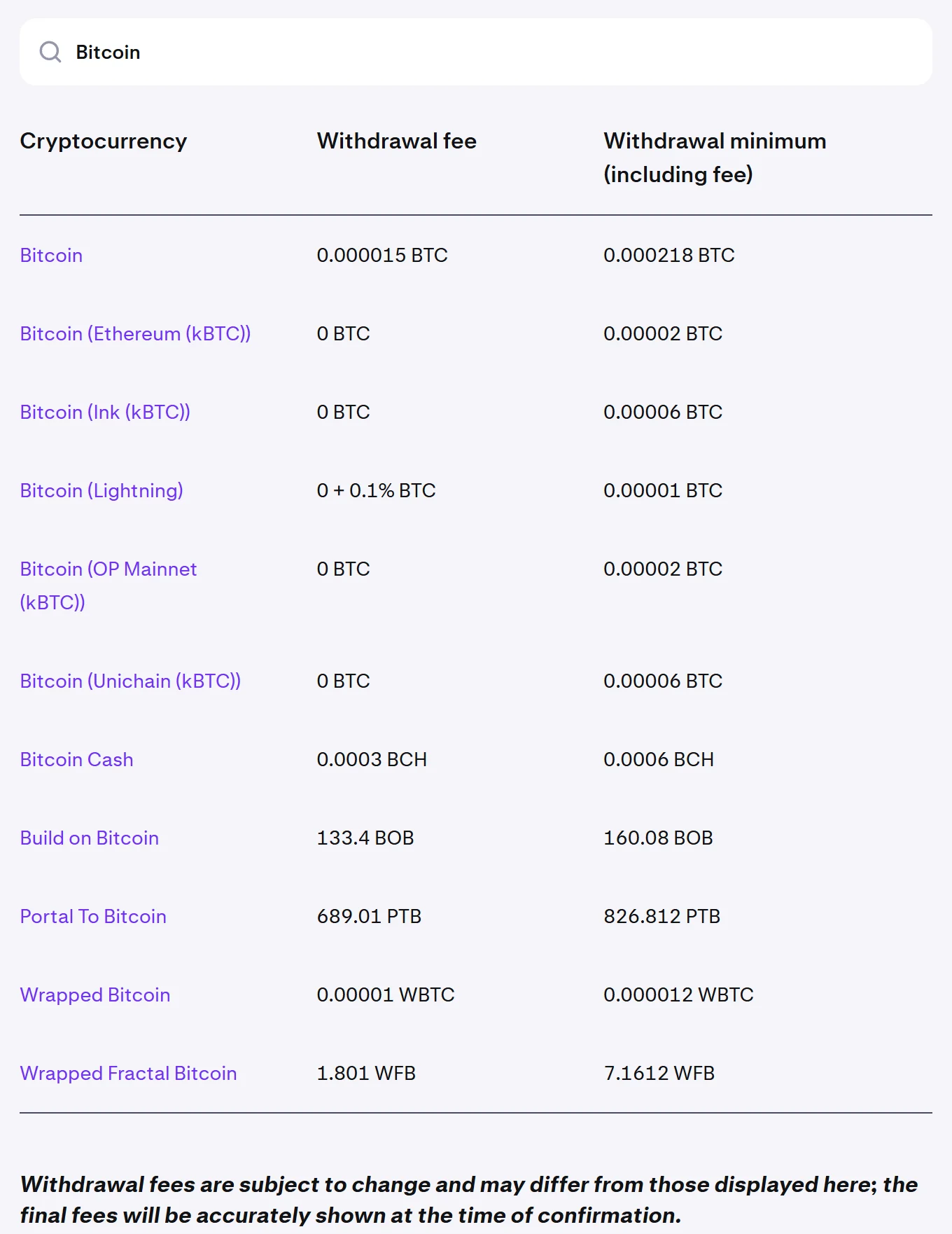
Read the note at the bottom of Kraken's withdrawal fees and minimums page: the fee that counts is the one on your confirmation screen. Filtered to Bitcoin, Sept 25, 2026.
The threshold isn't the only trigger, though. How much you're prepared to leave with the exchange, and for how long, can each justify moving coins earlier at a worse percentage. And buying weekly never obliges you to withdraw weekly.
Turn the fee into a threshold
Work in sats. One bitcoin is 100,000,000 satoshis (sats), so 0.00002 BTC is 2,000 sats and 0.000015 BTC is 1,500 sats. For a flat fee:
Required total debit = withdrawal fee ÷ acceptable fee fraction
The fee fraction here is the fee divided by the total BTC removed from your exchange balance. With Binance's fee and a 1% limit, you wait until you can withdraw 200,000 sats, about $170 at a BTC price near $84,000. With the fee taken out of that, 198,000 sats reach your wallet.
| Fee limit | Binance (2,000-sat fee) | Kraken (1,500-sat fee) |
|---|---|---|
| 2% | 100,000 sats (about $84) | 75,000 sats (about $63) |
| 1% | 200,000 sats (about $170) | 150,000 sats (about $125) |
| 0.5% | 400,000 sats (about $335) | 300,000 sats (about $250) |
Not sure which limit to pick? Measure what buying already costs you with the effective-price check on your usual order, and set the withdrawal limit no higher than that share. The withdrawal then never takes a bigger slice of your coins than the purchase did.
If you'd rather not measure, start at the 1% row: 200,000 sats on Binance, 150,000 on Kraken.
We read both fees on September 25, 2026, Binance's from its crypto withdrawal fee table and Kraken's from the page shown above. The dollar figures drift with the price, and exchanges change the sats figures without much notice too. So before you trust any table, this one included, open the withdrawal preview in your own account, pick the network your wallet uses, and write down three figures: the charge, the minimum, and the amount your wallet would receive. If the fee is a percentage or has several parts, skip the formula and work from that preview.
Watch the amount field. Some forms ask what the recipient should get and add the fee on top. Others subtract the fee from what you type. Ask for 200,000 sats to arrive with a 2,000-sat fee added, and the total debit is 202,000 sats, with the fee about 0.99% of it.
Your balance and time limits come first
Say you have 160,000 sats on the exchange and a 1% threshold of 200,000. Waiting only makes sense if 160,000 sats is still within both limits below.
A custody limit is the most value you're willing to leave with the provider. Set it in dollars or your local currency, since what you could stand to lose is a real-world amount, and revisit it when the price moves a lot.
A time limit stops small recurring purchases from sitting on the platform for months while you wait for a better ratio. Pick a maximum holding period or a review date. When it arrives, get a fresh quote and decide: withdraw, pause purchases, or buy elsewhere next time.
Weighing another provider? Compare what each leaves you after fees first. If Binance comes out ahead and serves your country, open and verify the account a few days before your review date. Binance says identity documents are usually reviewed within 48 hours.
So the full rule: review or withdraw when the fee drops below your chosen fraction, the balance reaches your custody limit, or the time limit runs out, whichever comes first.
If the custody or time limit trips first, pay the worse percentage. That's what those limits are for.
It cuts the other way too. A receiving wallet you haven't finished setting up and backing up doesn't get any safer because you hit the fee target. Sort out the wallet first.
Topping up with extra cash just to reach a round target defeats the purpose. Check, too, that the balance is actually withdrawable, because a purchase can be complete while a settlement hold still blocks the funds.
When one of your limits is reached, get a fresh preview and check the address and network before you confirm. Today's threshold isn't permanent, so redo the sum each time.
When the threshold should give way
A first withdrawal. Pay the extra fee for a small test. It's worth it as long as the amount meets the exchange minimum, stays within what you can afford to lose, and confirms before the larger transfer. Here's how to size the test.
A custody concern you can verify. If verified information from the provider makes you unwilling to leave the balance there, a higher fee fraction is a fair price. A social-media rumor on its own doesn't count as verified.
A fee rise with no deadline close. If the quote jumps while neither limit is near, check again later. Moving the existing balance to another exchange usually adds cost rather than saving it. Compare providers for future purchases instead.
Do more withdrawals cost you later?
Each on-chain withdrawal lands in your wallet as a separate output, or UTXO, even when you receive several times at the same address. Spend them together later and each one adds an input to the transaction. A standard native SegWit (P2WPKH) input adds about 68 virtual bytes (vB) on Bitcoin Optech's size calculator, so the extra cost is 68 vB times whatever fee rate you pay on the day you spend.
Now run two plans for the same 200,000 sats on Binance: one withdrawal, or four of 50,000. The four-withdrawal plan pays 6,000 extra sats in exchange fees today and leaves three extra inputs to spend later.
| Fee rate when you spend | What it reflects | Cost of 3 extra inputs |
|---|---|---|
| 1 sat/vB | Typical median since late 2025 | 204 sats |
| 43 sat/vB | Monthly median, April 2024 (halving) | 8,772 sats |
| 135 sat/vB | Monthly median, December 2023 | 27,540 sats |
The historical rows are approximate monthly medians of the median block fee rate, from mempool.space's block fee-rate chart. On September 25, 2026, mempool.space's live estimates ran from 0.2 to 2 sat/vB.
At today's rates it's no contest: 6,000 sats now against about 200 sats later.
The future-input side only catches up if fees return to 2023–24 congestion levels and you have to spend during them. You usually get to choose when you spend, and quiet periods are when combining small UTXOs is cheapest. Fewer, larger withdrawals still help on both counts. Just don't let fear of future inputs outweigh a fee you're paying today.
Does it cost to transfer Bitcoin to a cold wallet?
From an exchange, yes. You pay the exchange's withdrawal fee, currently 2,000 sats at Binance and 1,500 at Kraken for the Bitcoin network. Receiving costs your cold wallet nothing.
Between wallets you control, you pay only the network fee: transaction size times fee rate. A simple one-input, two-output send is about 141 vB, so at 1 sat/vB that's 141 sats, around 12 cents. Work out the size of your own transaction before assuming that figure. Why the exchange charges so much more than the network does is laid out in withdrawal fee vs network fee.
What is the minimum Bitcoin withdrawal?
It depends on the exchange and the network. In September 2026 the public figures were 10,000 sats (0.0001 BTC, about $8.40) at Binance, 21,800 sats including the fee at Kraken, and 50,000 sats at Bitget, going by Bitget's published coin list.
A minimum is what the exchange will process. It isn't what makes sense to send. At Binance's minimum, the 2,000-sat fee eats 20% of the withdrawal. Use the minimum for a test and the threshold for everything after.