
Withdrawals
Why Is the BTC Withdrawal Fee Higher Than the Network Fee?
In a batched withdrawal, your output needs about 9 to 31 sats of miner fee at 2026 rates. The rest of a 2,000-sat exchange charge is the exchange's own price, not a network cost.
You paid a 2,000-sat withdrawal fee, pasted the TXID into a block explorer, and found that the whole transaction, with your payment as just one of its outputs, paid a miner fee in the same range or less. Your share of it was a sliver. Nobody made a mistake. Binance's BTC fee on the Bitcoin network was 2,000 sats in September 2026 (Kraken's was 1,500), and both figures can be right at once. The withdrawal fee is a price the exchange sets for its service. The miner fee is what the transaction paid to get into a block.
Sending from your own wallet instead? That fee has different causes and fixes.
How much of the miner fee your output actually uses
The gap starts with batching. Exchanges often pay many customers in one transaction, funded by a single set of inputs, and your withdrawal adds just one output to it. A native SegWit (bc1q) output is 31 vB on Bitcoin Optech's size calculator.
At the 0.3 to 1 sat/vB rates common in 2026, that output needs about 9 to 31 sats of miner fee. Now set it next to the exchange's price:
| Sats | |
|---|---|
| Miner fee for one bc1q output at 0.3 sat/vB | about 9 |
| Miner fee for one bc1q output at 1 sat/vB | 31 |
| Kraken Bitcoin withdrawal fee | 1,500 |
| Binance Bitcoin-network withdrawal fee | 2,000 |
We copied the exchange fees straight from Binance's public fee page and Kraken's withdrawal fee list in September 2026. Your withdrawal screen has the final figure.
So on a quiet day the withdrawal fee runs roughly 50 to 200 times the miner fee your output uses.
That isn't a mistake. It's pricing. One flat price has to cover busy days as well as quiet ones, and busy days have been scarce: the typical median fee rate has sat around 1 sat/vB since late 2025, so for now most of that cushion stays with the exchange. Coinbase's fee disclosure is unusually candid here, saying its charge can differ from the network fee it pays because of batching and changing network conditions.
It also means there's nothing to dispute. You were charged the price you accepted, and a support ticket won't get the difference refunded. What you can change is how often you pay it, and by which route:
- Withdraw less often. A 2,000-sat fee is 2% of a 100,000-sat withdrawal and 0.2% of a 1,000,000-sat one. Setting a withdrawal threshold turns that into a rule.
- Take a cheaper route. Binance's Lightning withdrawal was 100 sats in September 2026, and Lightning vs on-chain explains when your wallet can receive it.
Is there a Bitcoin withdrawal fee calculator?
Not really, because there's nothing to calculate. Each exchange publishes a fixed price per network, and the withdrawal screen shows it before you confirm. To compare providers, read the fee pages themselves. Binance puts every BTC network in one table, and Kraken's list has a search box.
Read the network name as carefully as the number. On Binance's table in September 2026, the "Bitcoin" row charged 0.00002 BTC with a 0.0001 BTC minimum. A separate "BTC (SegWit)" row charged 0.001 BTC with a 0.002 BTC minimum, fifty times the fee on the "Bitcoin" row. Withdrawals on that row were switched off when we checked in September and October 2026. If it comes back, picking it costs 100,000 sats instead of 2,000. Kraken's minimum of 0.000218 BTC includes its fee, so the smallest withdrawal you can make there delivers 0.000203 BTC.
Find your row in a batched transaction
Copy the Bitcoin transaction ID (TXID) from the completed withdrawal and search it on an explorer such as mempool.space. The exchange's internal withdrawal number won't work there. If you can't spot the TXID, where Binance and wallets show it has the menu paths.
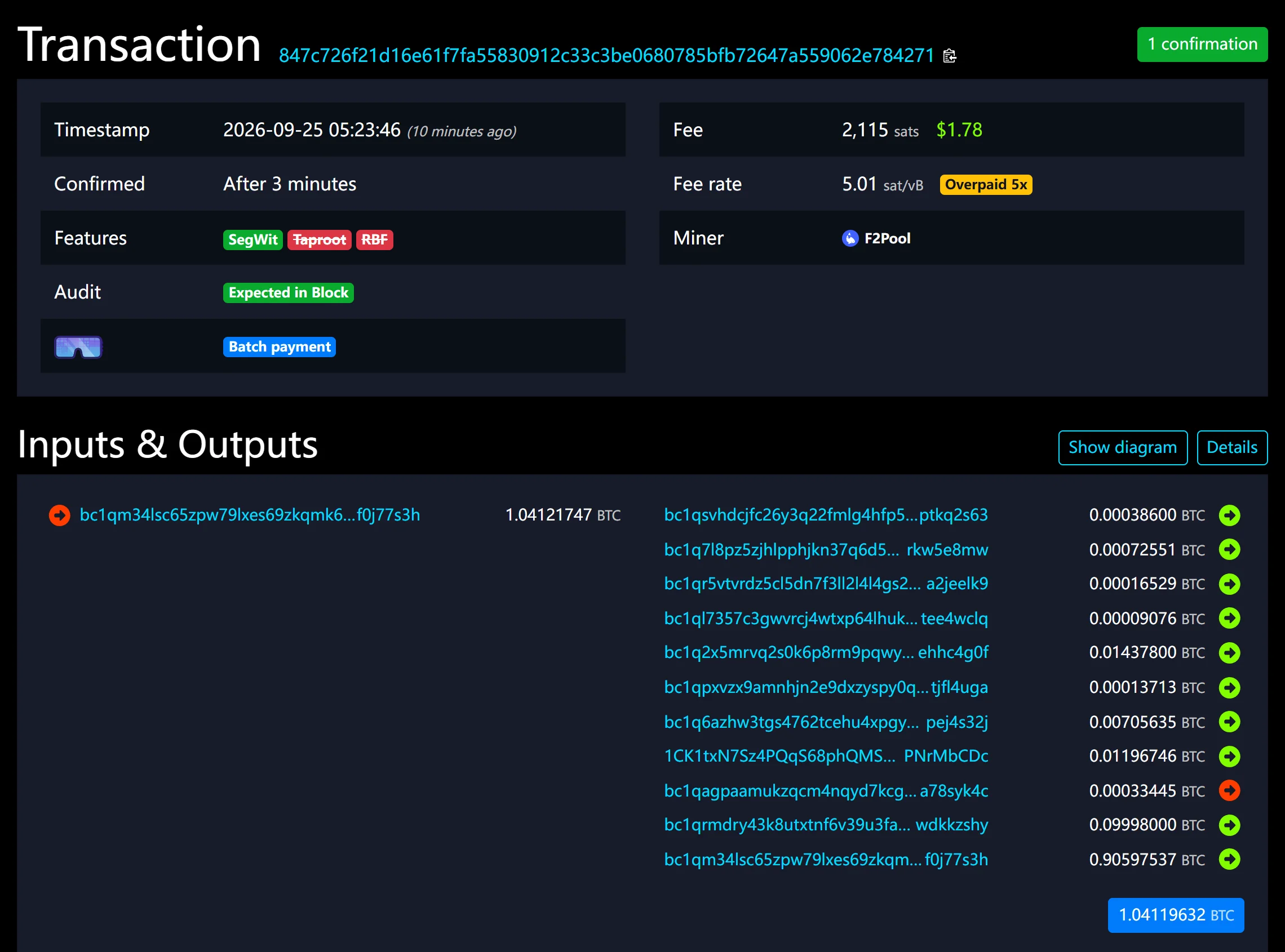
One input, eleven outputs, one fee for all of them. It's a stranger's transaction, shown for the layout.
Here's how to read it. One input funds eleven outputs, listed in order down the right-hand column. The last output pays back to the input's own address, which usually marks the sender's change. The 2,115-sat fee covers the whole transaction, about 422 vB. Each bc1q output accounts for 31 vB of that, or about 155 sats at 5.01 sat/vB. mempool.space flags the rate "Overpaid 5x," its estimate that the sender paid about five times the rate that block needed.
In your own withdrawal, go down the output list to the address you gave the exchange, and check that the amount matches what the exchange said you'd receive. The largest output and the transaction total aren't yours, so ignore both. Outputs are numbered from 0 in the order shown, which means support may call yours, say, output 3. If one address appears twice, tell the outputs apart by amount.
The fee rate on that page is sats per vB. It isn't a percentage, and it isn't your fee. What sat/vB means shows how to turn it into sats and dollars.
Nor will the explorer's total be taken from your wallet later. Your output already holds a fixed amount. When you eventually spend it, you pay the fee for that future transaction instead.
Three figures on the withdrawal receipt
A completed withdrawal record should show the total taken from your exchange balance, the withdrawal fee, and the amount the recipient was due. Put all three in sats before comparing.
A 302,000-sat debit that includes a 2,000-sat fee should deliver 300,000 sats. Some exchanges instead treat the amount you type as the total, fee included, so the same 300,000 would arrive as 298,000. The label on the amount field tells you which arithmetic applies.
If the sats match but the dollar value moved, compare the conversion rate and timestamp. A changing fiat display isn't a second charge.
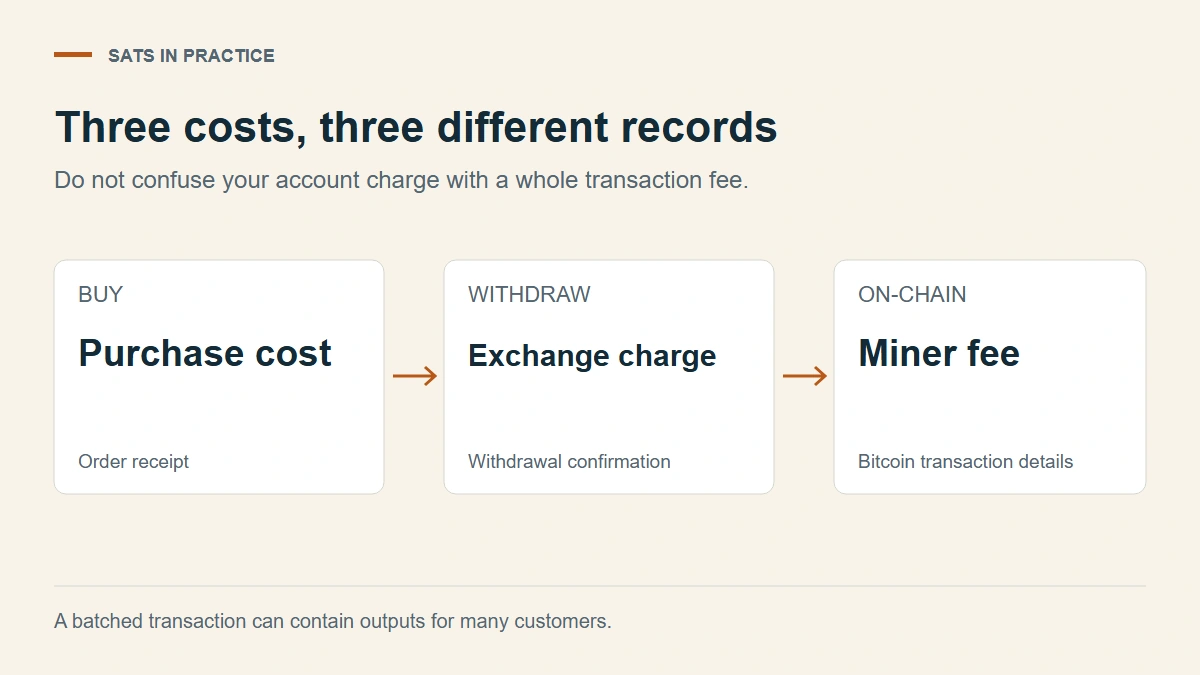
Three different costs tend to get mixed up here:
| Cost | When it occurs | Where to check it |
|---|---|---|
| Purchase cost | Cash is exchanged for BTC | Order preview and completed receipt |
| Withdrawal fee | The exchange sends BTC out | Withdrawal confirmation and account history |
| Miner fee | The transaction is included in a block | Transaction page on a Bitcoin explorer |
The labels don't help. Some exchanges call their own withdrawal charge a "network fee," which makes a service price sound like a pass-through cost. Go by what the field measures, not what it's called.
What support can and can't fix
Check two things first. Did the exchange debit what it quoted? Did your address receive the promised amount? If both answers are yes, the withdrawal is fully accounted for, however the miner fee looks.
Contact the exchange through its own website or app if the completed debit differs from the confirmed quote, your output differs from the expected receipt, or a withdrawal marked complete has no TXID after the stated processing time. A withdrawal that hasn't arrived follows a different checklist.
Send the details in what to send support, plus the one number a fee dispute turns on: the difference in sats between the quote and the debit. If the reply doesn't deal with that difference, the steps for escalating past a support ticket apply to a fee dispute too. Posting a transaction screenshot in public can tie your address to your identity, so share details privately.