
Withdrawals
What Does sat/vB Mean? Turn a Fee Rate into Sats and USD
sat/vB is satoshis per virtual byte. A 141-vB payment at 1 sat/vB costs 141 sats, about 12 cents at $84,000 per BTC, whatever amount you send.
sat/vB means satoshis per virtual byte: the price your transaction offers miners for each unit of block space it takes up. Multiply that rate by the transaction's size and you have the fee:
fee in sats = size in vB × rate in sat/vB
Take a typical single-signature payment of about 141 vB. At 1 sat/vB it costs 141 sats. Notice what's missing from that sum: the amount being sent. It works like postage charged by the size of the parcel, not by what's inside, so the same rule covers a $20 payment and a $20,000 one.
That's the fee your own wallet pays. An exchange's withdrawal charge is a separate price, and usually far higher than the miner fee.
What 1 sat/vB means in sats
A satoshi (sat) is the smallest unit of bitcoin: 100,000,000 sats make 1 BTC. A virtual byte (vB) is how Bitcoin sizes transactions for fees. Virtual size is weight divided by four (BIP 141), and SegWit signature data weighs less. That's why the same payment is smaller from a bc1 address than from an old address starting with 1.
For a 141-vB payment:
| Fee rate | Calculation | Fee |
|---|---|---|
| 0.3 sat/vB | 141 × 0.3 | about 42 sats |
| 1 sat/vB | 141 × 1 | 141 sats |
| 2 sat/vB | 141 × 2 | 282 sats |
| 10 sat/vB | 141 × 10 | 1,410 sats |
| 30 sat/vB | 141 × 30 | 4,230 sats |
Fractional rates are normal now, and the wallet simply rounds the fee to whole sats. That's why the first row says "about".
What fee rates look like in 2026
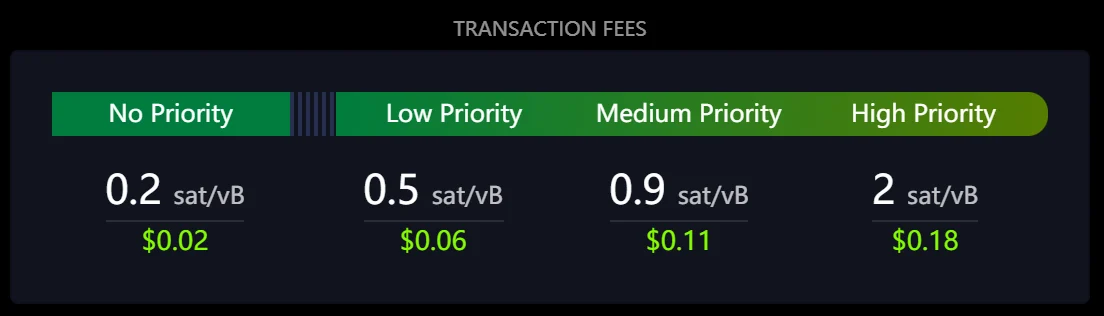
Read the sat/vB figures rather than the dollars, which mempool.space works out for a 140-vB native SegWit transaction. September 25, 2026.
On September 25, 2026, mempool.space suggested 0.2 sat/vB for no priority, 0.5 for low, 0.9 for medium, and 2 for high, with 0.1 as the minimum. That was a normal day. On mempool.space's block fee-rate chart, the typical (median) rate miners accepted has been about 1 sat/vB in every month since September 2025.
Busy periods look nothing like that. The monthly median was about 135 sat/vB in December 2023 and about 43 around the April 2024 halving. On halving day itself, April 20, 2024, blocks paid a median of more than 800. So the 10 and 30 rows in the table aren't scare numbers. Bitcoin has already been well past them.
Rates below 1 sat/vB became practical when Bitcoin Core 29.1 (September 2025) lowered its default minimum relay fee rate from 1 to 0.1 sat/vB. Core's own wallet kept its fee rates unchanged, though, and nodes on older settings still refuse anything under 1 sat/vB. A 0.2 sat/vB transaction can therefore spread slowly or miss some miners.
If your wallet won't go below 1, that's its relay floor, not a fault. On a 141-vB payment the floor costs 141 sats, about 12 cents at the price used below. For one everyday payment that isn't worth working around. It starts to matter when the transaction is large. For the current picture, check the mempool.space fee panel just before you send.
What does 1 sat/vB cost in USD?
Convert the fee from sats to BTC, then multiply by the price:
fee in USD = size in vB × rate in sat/vB ÷ 100,000,000 × BTC price in USD
With BTC at about $84,000 (September 25, 2026):
- 141 vB × 1 sat/vB = 141 sats = 0.00000141 BTC ≈ $0.12
- 141 vB × 0.3 sat/vB ≈ 42 sats ≈ $0.04
- At the December 2023 median of about 135 sat/vB: 141 × 135 = 19,035 sats ≈ $16 at the same price
A handy rule, then: on a 141-vB payment, each 1 sat/vB costs about 12 cents at $84,000 per BTC. For the day's price, use your exchange's BTC/USD quote or mempool.space, which publishes its feed at https://mempool.space/api/v1/prices. Record the fee in sats too. 141 sats stays 141 sats when the dollar value moves.
Does sending $100 cost less than $10,000?
No. Back to the parcel: the network fee follows the transaction's size in vB, not the value inside it. Sending $100 or $10,000 from one bc1q coin to one recipient, with change coming back, produces the same 141-vB transaction and the same fee at the same rate.
The amount matters only indirectly. Say the $10,000 sits in twenty small coins. All twenty become inputs at 68 vB each, while a $100 payment funded by one coin stays small. Why a send gets expensive walks through that diagnosis. Exchange withdrawals ignore all of this and follow a price list: Binance's fee table showed a flat 2,000 sats for an on-chain BTC withdrawal in September 2026, whatever the amount.
Input and output sizes by address type
Input size depends on the address type holding the coin you spend. Output size depends on the address you pay and on your change address. The prefix tells you the type:
| Address starts with | Type | Input | Output | 1 input, 2 outputs |
|---|---|---|---|---|
| 1 | Legacy (P2PKH) | 148 vB | 34 vB | 226 vB |
| 3 | Nested SegWit (P2SH-P2WPKH) | about 91 vB | 32 vB | about 165 vB |
| bc1q (42 characters) | Native SegWit (P2WPKH) | 68 vB | 31 vB | 140.5 vB |
| bc1p | Taproot (P2TR) | 57.5 vB | 43 vB | 154 vB |
The 1, bc1q, and bc1p rows are from Bitcoin Optech's transaction size calculator. It has no single-signature 3 type, so that row uses Jameson Lopp's size calculator (90.75 vB per input). All four rows assume single-signature coins. A 3 address can also be multisig, and a 62-character bc1q address is a script (P2WSH) address, so use your wallet's figure for those.
A legacy input is about 2.2 times the size of a native SegWit one, so old coins cost more to move at any rate. Taproot has the smallest input but a larger output.
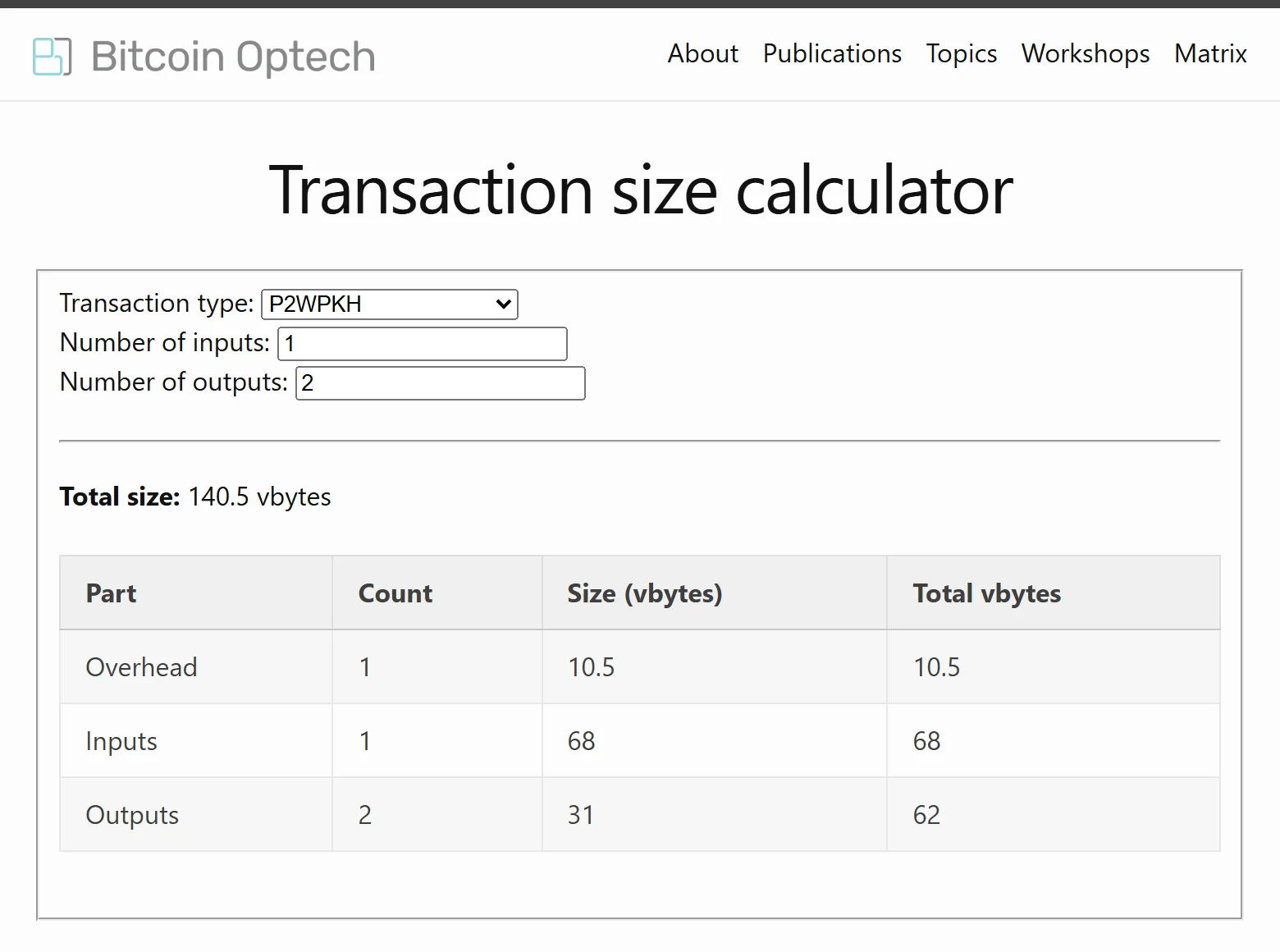
The 140.5-vB total at the bottom is where this article's 141 comes from, rounded up.
For a transaction that uses only bc1q addresses, a quick estimate is size ≈ 11 + 68 × inputs + 31 × outputs, with Optech's 10.5-vB overhead rounded up. One input and two outputs give 141 vB; ten inputs and two outputs give 753 vB.
Find the size of your own transaction
Create an unsigned send preview in your wallet with the real recipient and amount. Note these four figures:
- The number and address type of the selected inputs.
- The number and address type of the outputs, including change.
- The estimated size in vB.
- The fee rate in sat/vB.
Then look at the total fee and the change. You don't have to sign or broadcast anything to see the cost.
If the wallet shows a size, trust it over any calculator, because it knows which coins it plans to spend. Otherwise cross-check in Optech's calculator, and set the type to match your inputs first. The calculator opens on legacy P2PKH, which would put a one-input, two-output bc1q payment at 226 vB instead of 140.5.
Mixed input types, multisig, and unusual scripts need the wallet's own preview. A single-type template will get them wrong. And don't delete the change output to make a calculation look cheaper: the change is your money coming back.
Low rates, deadlines, and the relay floor
Wallet estimates and the mempool.space categories forecast demand. They don't book you a block. For something that can wait, such as combining your own coins, a low rate and some patience work well. Before sending below 1 sat/vB, make sure your wallet can raise the fee later. Sparrow marks its transactions as replaceable (RBF) by default, and Trezor Suite shows a Speed up button on a pending send. If it's still unconfirmed when you need it, the stuck-transaction steps cover bumping the fee or waiting.
A deadline changes the approach. Ask the recipient how many confirmations they need, use your wallet's current estimate, and stay at or above your wallet's relay floor, even if a website shows a lower number.
After changing the rate, recheck the total. A modest rate can still produce a large fee when many inputs are selected, and choosing inputs with coin control changes the size side of the sum without touching the rate. If you want to see where the rate and total sit in a Trezor Suite preview, Trezor's fee guide has one.
Your own arithmetic and the wallet preview should agree once the units line up: size in vB, rate in sat/vB, fee in sats. When they don't, the difference is almost always an extra input or a change output you didn't count.