
Withdrawals
Lightning vs On-Chain Bitcoin Withdrawal for Small Amounts
Lightning only works if your wallet gives you an invoice. It usually costs a fraction of an on-chain withdrawal but comes with per-withdrawal limits, and a wrapped token is not bitcoin.
Binance's BTC withdrawal menu lists several networks, and in September 2026 the open ones charged anywhere from 28 sats to 2,000 sats. The cheapest row and the most expensive one don't deliver the same thing. The wallet you're sending to picks the route. The fee column comes second.
The rule is short. Native BTC to an ordinary Bitcoin wallet: Bitcoin network. A Lightning invoice in hand: Lightning. A token network only if you actually want that token on that chain.
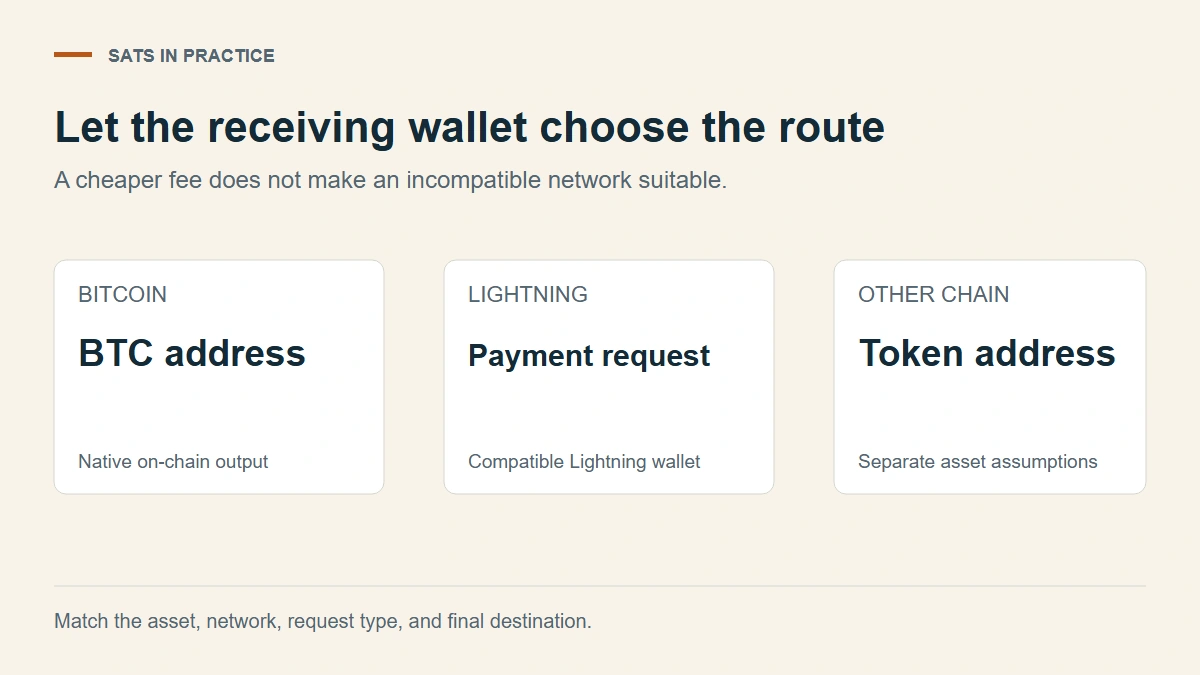
What does your wallet's Receive screen show?
Open the exact account that should receive the funds. A multi-asset app can hold several incompatible accounts, so the app's name tells you nothing about the network.
| What the destination gives you | Route to choose | Details that must agree |
|---|---|---|
| An on-chain Bitcoin address | Bitcoin network | BTC network, address type, full address |
| A Lightning invoice | Lightning | Amount, expiry, and the invoice itself |
| An address for a bitcoin-backed token on another chain | That token on that chain | Contract, network, and the gas coin needed to move it |
Bitcoin mainnet addresses start with 1, 3, bc1q, or bc1p. The prefix catches an obvious mismatch and nothing more: it proves neither compatibility nor ownership. For that, check the complete address on the wallet itself (Trezor's receiving guide shows how).
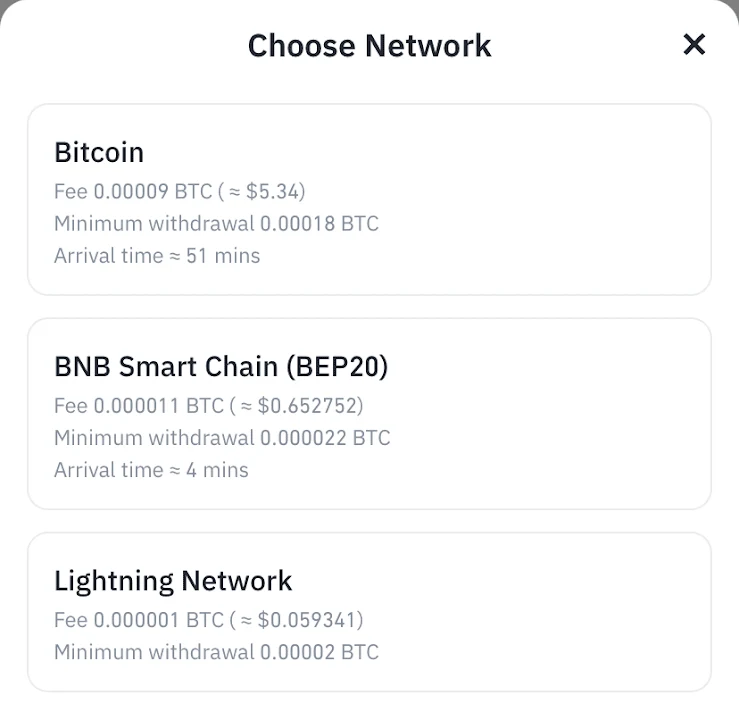
Bitcoin, BNB Smart Chain and Lightning sit as separate rows. The fees and minimums in this 2024 image from Binance's Lightning help article are out of date, so read yours from your own account.
On-chain: the direct route
An on-chain withdrawal creates an output your Bitcoin wallet's keys can spend. When the destination is a standard Bitcoin account, this is the route. In September 2026 it cost 2,000 sats at Binance and 1,500 at Kraken. Minimums and sources are in our fee table.
A fee that looks big next to a small balance can be a reason to wait. It doesn't make an incompatible network any safer. Never edit a Bitcoin address by hand to make an exchange accept it. If the service rejects your address type, the wallet's own instructions will show how to create a compatible account and what that means for your backup. Verify the new address before you paste it anywhere.
Lightning withdrawals: fees and limits
Lightning moves bitcoin through payment channels instead of a new on-chain output, and the pricing shows it. Here is what the two exchanges charged when we checked on September 25, 2026:
- Binance: 100 sats per withdrawal, 2,000-sat minimum, and a 1,000,000-sat (0.01 BTC) maximum per withdrawal, about $840 at current prices. Fee and minimum come from its fee table; the cap is the per-withdrawal limit Binance publishes for its Lightning network. Above the cap, split the amount into several withdrawals if your wallet can receive them, or use the Bitcoin network.
- Kraken: 0 + 0.1% of the amount, with a 1,000-sat minimum (fees and minimums page). On 100,000 sats that's 100 sats. It only catches up with Kraken's 1,500-sat on-chain fee at 1,500,000 sats.
Binance sets three conditions in its help article: Lightning may not be offered in your region, the withdrawal amount must match the amount in the invoice, and an invoice with no amount won't process. A missing Lightning row has two causes by the same article. Either the app is older than version 2.67.0, or you're outside the places where local rules let Binance.com offer the network. Updating the app is the one fix on your side. If the row still isn't there, withdraw on the Bitcoin network.
Getting a Lightning invoice
The exchange can't send over Lightning until your wallet asks for the payment, so the invoice comes first.
Custodial or self-custodial. A custodial service holds the bitcoin for you, and receiving there is like depositing to another exchange account. Coinbase is one example. It takes Lightning through invoices only, not Lightning addresses (its Lightning help page). A self-custodial wallet keeps the keys on your device. Phoenix, from ACINQ, runs a Lightning node on your phone; ACINQ's own FAQ calls it trust-minimized rather than trustless and spells out what still depends on ACINQ.
Amount and expiry. An invoice usually fixes an amount and always carries an expiry. If the invoice doesn't set one, the Lightning invoice specification makes it one hour. Binance's own deposit invoices expire after 30 minutes. Other wallets choose their own.
The order of steps:
- In the receiving wallet, open Receive, choose Lightning, and enter the exact amount.
- Copy the invoice. At Binance it must be a standard invoice beginning
lnbc. A Lightning address that looks like an email won't be accepted. - Paste it into the withdrawal form, enter the same amount, and read the fee and final amount.
- Confirm before the invoice expires. If it has expired, generate a new one rather than editing anything.
Lightning now, cold storage later: count both legs
Headed for cold storage? Then compare what reaches cold storage, not the first fee. Phoenix publishes its fees, which makes it a clean worked case:
- Receiving over Lightning is free when your channel has room, but costs 1% plus mining fees when it doesn't. A new wallet has no channel yet. Phoenix's fee table lists channel creation separately, at 1,000 sats, so a first payment may pay both.
- Sending on-chain later costs the mining fee you choose. At around 1 sat/vB, that's typically a few hundred sats or less.
For 100,000 sats leaving Binance, that gives roughly:
| Route | Fees along the way | Lands in cold storage |
|---|---|---|
| Bitcoin network, direct | 2,000 sats | 98,000 sats |
| Lightning to a Phoenix wallet with room, then on-chain | 100 sats + mining fee | about 99,700 sats |
| Lightning to a brand-new Phoenix wallet, then on-chain | 100 + 1% (about 1,000) + possibly 1,000 for channel creation + mining fees | about 97,500 to 98,500 sats |
The first Lightning withdrawal into a fresh self-custodial wallet can cost as much as going direct, or more. Once the channel exists, repeated small withdrawals can come out ahead, especially while on-chain fees stay low. In a fee spike the on-chain leg gets expensive too.
So for a one-off move to cold storage, withdraw on-chain. The two-leg route only pays if you'll keep topping up the same Phoenix wallet.
Phoenix also rejects an incoming payment by default when its fee would exceed 5,000 sats or half the amount, which means a small first transfer can bounce. A rejected Lightning payment goes back to the sender. Check that the sats are back in your exchange balance before retrying, then send an amount whose fee stays under both limits, or raise the limit in Phoenix under Settings > Channel management if you accept the higher fee.
Two transfers also mean two destinations to verify and an invoice that can expire. Count those along with the fees.
Wrapped bitcoin vs bitcoin
Binance's BNB Smart Chain route costs 28 sats, which looks like a bargain next to 2,000. What arrives is a BEP-20 token called BTCB at a BNB Smart Chain address. The Ethereum row, at 930 sats as of October 2026, sends Binance Wrapped BTC (BBTC). Neither is a Bitcoin UTXO your wallet's keys control. Both hold their value only while the issuer keeps them redeemable. Moving them takes BNB or ETH for gas, and getting back to native BTC means another service and another fee.
These rows aren't a cheaper Bitcoin row. They're a different asset. If native BTC in your own wallet is the goal, skip them.
Already sent it on the wrong network?
Check the network name on the withdrawal record first. Do not send a second payment as a fix. At Binance, the address checks narrow down what can have happened: the Lightning row only takes an invoice, and the BNB Smart Chain and Ethereum rows only take addresses starting with 0x, so a token can't land on a Bitcoin address by mistake. Whether you get it back depends on who controls that 0x address, and the steps for each case cover what to send and to whom. If it came from your own wallet, the token is already there and can be moved back to native BTC. If the address belongs to another exchange, only that exchange can return it.