
Withdrawals
How Much to Send in a Bitcoin Test Transaction
Send enough to clear the exchange minimum and little enough that losing it wouldn't hurt. Test sizes with their fee share, typical waits, and five results to check before the rest.
A test transaction is a small withdrawal sent ahead of the real one, so that a wrong address, network, or account costs you a little instead of everything. How little? There's no standard answer like $10 or 0.001 BTC. The exchange's minimum and fee set the floor, and what you could afford to lose sets the ceiling.
The Binance public fee table we pulled up in September 2026 put the Bitcoin-network minimum at 10,000 sats (0.0001 BTC) and the fee at 2,000 sats, about $8.40 and $1.70 at a BTC price near $84,000. The smallest possible test spends a fifth of itself on the fee. Once, that's a price worth paying. Dollar amounts drift with the price, so convert with today's quote.
Have the receiving wallet ready before you open the withdrawal form. The rest of the money waits until the test has confirmed in the right account.
1. Prepare the receiving wallet
Download the wallet from its maker's own site or app store listing. Finish setup, write down the backup the way its instructions say, and use its built-in check to confirm the backup. Receiving bitcoin proves an address works; it proves nothing about whether you can restore the wallet later.
For a hardware wallet, open the Bitcoin account you mean to use, generate a receive address, and compare it on the device's own screen (in Trezor Suite, that's the Verify button). With a passphrase, remember that a different passphrase opens a different wallet. A meaningful balance only goes into an account whose backup you've confirmed.
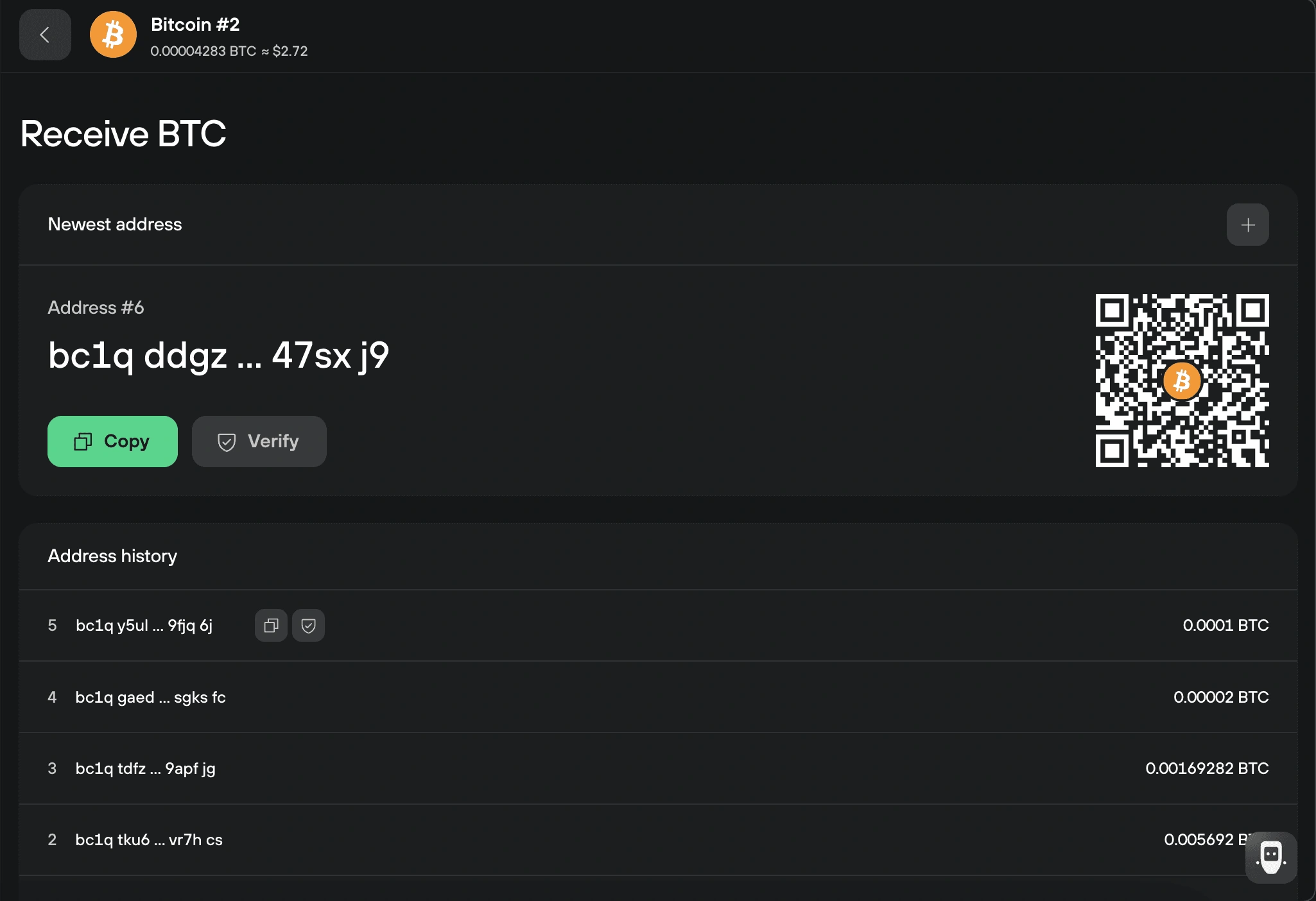
Verify is the button to press: it puts the address on the device screen. From Trezor's receiving guide. The address and QR code are Trezor's demo data, so never send funds to them.
2. Copy the destination, then choose the route
Copy the address from the wallet's Receive screen. For an ordinary on-chain Bitcoin wallet, choose BTC on the Bitcoin network at the exchange. A Lightning invoice is a different kind of destination, and a bitcoin-pegged token on another blockchain is a different asset. A lower fee doesn't make either one compatible with an on-chain address. If you're unsure which kind your wallet gave you, check it against the three routes.
After pasting the address into the exchange, compare the whole thing with the one on your device, then again at the final confirmation. The first and last few characters aren't enough. Check all of it.
An address allowlist can prevent later typing mistakes, but a saved entry is only as good as the address you verified when you saved it. Adding one may also start a security delay, so it might not be usable straight away.
On a newly opened Binance account, the withdrawal form may not open at all: Binance requires at least three authentication methods to be active before any withdrawal. The Binance withdrawal walkthrough covers that setup and the pop-ups that can follow.
3. Choose the test amount from the quote
Read four figures on the withdrawal preview: the minimum, total BTC debit, fee, and expected receipt. Then work out whether the minimum applies to the amount you request or the amount the wallet receives. Kraken's 0.000218 BTC minimum, for example, includes the fee. Binance's fee table doesn't say either way, so ask the preview: enter 10,000 sats and see whether the form accepts it and what it says you'll receive. If it refuses, raise the amount until it's accepted and note the receive figure. That tells you which way the minimum works.
At Binance's September 2026 quote, with the 2,000-sat fee taken from the total debit:
| Test debit | Net received | Fee share | Roughly |
|---|---|---|---|
| 10,000 sats | 8,000 sats | 20% | $8.40 |
| 50,000 sats | 48,000 sats | 4% | $42 |
| 100,000 sats | 98,000 sats | 2% | $84 |
Whatever size you choose, the test adds the same one extra fee, 2,000 sats. What the size changes is how much is at risk and what's left in your wallet afterward. The 8,000 sats from a minimum test make a small output. As an input it adds about 68 vB, and at December 2023's monthly median of 135 sat/vB spending it would cost more than it holds. So if $42 is an amount you could lose without real damage, test with 50,000 sats. Drop to the minimum only if it isn't.
If the minimum and fee push the test above what you could afford to lose, stop there. Waiting, reading up, or trying another route you're eligible for are all reasonable outcomes. You don't need to buy more bitcoin just to make today's test possible.
4. Submit the test once
At the final preview, read the form as one sentence: BTC, on the Bitcoin network, to this fully verified address, for this total debit, producing this net receipt. The amount must meet the minimum, and the total debit including the fee must stay inside your test limit.
Complete the exchange's security confirmation and save the withdrawal reference. A slow screen or an empty wallet isn't a reason to submit again.
How long the test should take
There are two waits. First the exchange processes the request and broadcasts the transaction. How long that takes depends on the exchange, and a withdrawal reference alone doesn't prove it happened. Once there's a transaction ID, the Bitcoin network takes over. Blocks arrive every 10 minutes on average, and most wallets mark a payment as confirmed after one block, so a broadcast test often shows as confirmed within 10 to 20 minutes. Individual blocks can take much longer.
Paste the transaction ID into a block explorer to find the output addressed to you and its confirmation count. The explorer's total fee may cover other customers in the same batch, and withdrawal fee vs network fee explains why that isn't your bill.
An hour or more with no transaction ID, no confirmation, or nothing in the wallet? Do not send again. Find which stage it's stuck in first.
5. Decide from the test result
Compare what the wallet shows with the preview, and match it to one of these before you send more:
- The expected amount, in the account you meant: the route worked under the conditions you checked. Get a new quote before sending the rest, because the fee or your available balance may have changed.
- Exactly the withdrawal fee less than you typed: the exchange took the fee out of the amount instead of adding it on top. Nothing is missing, and the three figures on a withdrawal receipt show how to read it.
- The coins, but in another account of the same wallet: they're still yours. Pick the account you'll use and take the main withdrawal's address from that one.
- Nothing in the wallet, though the explorer shows a confirmed output to your address: check the wallet's network, account, sync status, and passphrase.
- An output to an address you didn't generate: stop and work through the unfamiliar-address checks.
If the exchange's record disagrees with the on-chain destination or amount, contact the exchange with both.
For the main withdrawal, take a fresh address from the same verified account and repeat the full comparison. Reusing the test address keeps the destination the same but links the two payments publicly, and it gains you nothing, since it doesn't merge their UTXOs or excuse you from verifying the form again.
The second quote also shows what the test cost overall. With a 50,000-sat test and a 450,000-sat main withdrawal, two 2,000-sat fees come to 4,000 sats across 500,000 sats of debits, or 0.8%. Sending the full amount once would have cost 0.4%. The difference is the price of the check.
A confirmed test shows that this withdrawal reached this account. It doesn't test recovery from your backup, and it doesn't vouch for a different address or network.