
Buying Bitcoin
Weekly vs Monthly Bitcoin DCA Differed by 0.2% Over 3 Years
A $1 fixed fee costs $12 a year on a monthly plan and $52 on a weekly one. Over three years of real prices, the schedule itself moved the average cost by only about 0.2%.
Buy $100 of bitcoin once a month or about $23 every week, and you end up paying almost the same average price. We ran both schedules over three years of hourly prices, from September 2023 to August 2026, and the typical weekly result and the typical monthly result landed about 0.2% apart. Call it a tie. On a small budget, what actually separates the two plans is how each order gets charged.
Dollar-cost averaging (DCA) means buying a fixed cash amount at regular intervals, sized to what's left after bills and a cash buffer. It doesn't prevent losses, and no schedule guarantees a better average price.
$25 a week is more than $100 a month
Do the arithmetic first. Across 52 purchases, $25 a week is $1,300 a year, an average of $108.33 a month. A $100 monthly purchase is $1,200 a year. And some calendar months will contain five weekly buys.
So the two plans people treat as interchangeable don't even spend the same money. A fair comparison starts from one annual cash limit, purchase charges included. For $1,200, that's $100 a month or about $23.08 a week ($1,200 divided by 52).
The fee structure can decide the schedule
Suppose every order costs $1, paid out of the same $1,200 annual budget, and nothing else is charged.
| Schedule | Orders per year | Cash allocated per order | Annual fixed charges |
|---|---|---|---|
| Monthly | 12 | $100.00 | $12 |
| Weekly | 52 | About $23.08 | $52 |
| Daily | 365 | About $3.29 | $365 |
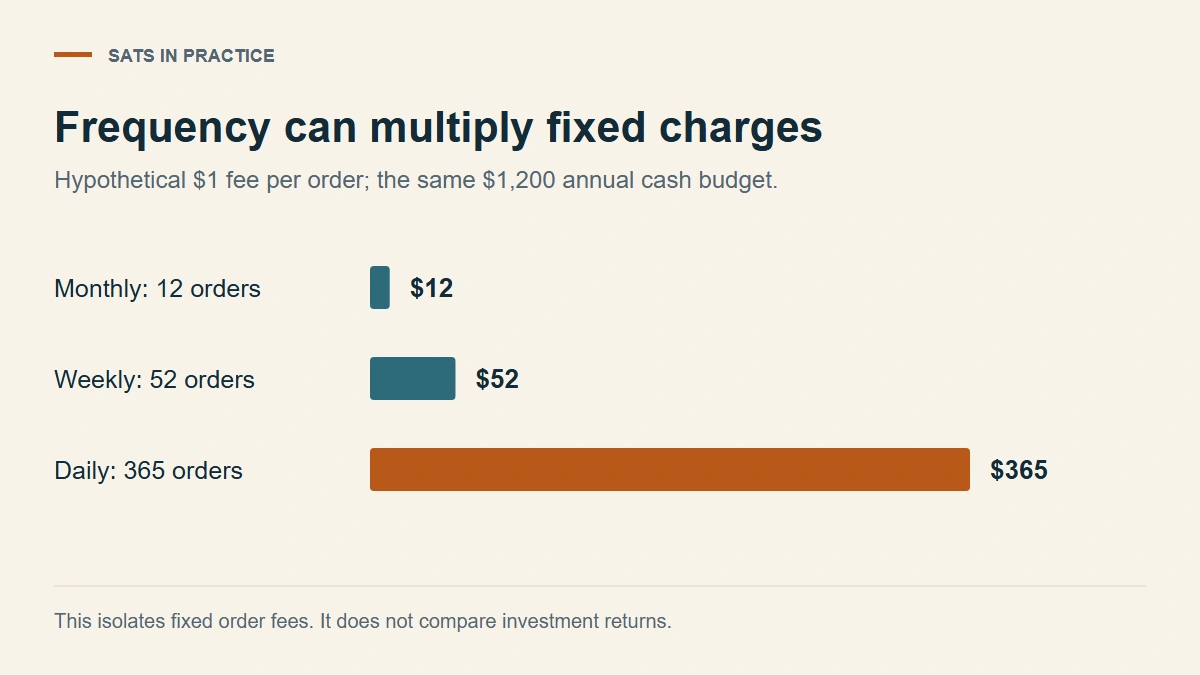
Swap in a 0.5% fee with no minimum and all three bars shrink to the same $6.
Daily buying leaves $835 for bitcoin, before any spread. If the provider adds the $1 on top instead, the plan goes over $1,200 unless you shrink the purchases themselves. With a fixed charge per order, monthly wins on cost, and not narrowly.
Now replace the fixed charge with a 0.5% fee and no minimum. The fee on $1,200 is $6 whether you place 12 orders or 52, and monthly stops saving anything. The schedule becomes a budgeting choice: weekly may suit weekly pay, and monthly may be easier to fund right after a monthly payday.
Real pricing is messier. A percentage, a minimum charge, a spread, and payment fees can all stack, and a recurring purchase may be priced differently from an exchange's advanced trading screen. Coinbase's fee disclosure is a good example of why the payment method and the purchase preview matter. Use the quote for the product you'll actually use.
Does the day of the week or daily buying get a better price?
Not by enough to plan around. Here's the same $1,200-a-year budget from September 1, 2023 to August 31, 2026, buying at 12:00 UTC with no fees:
| Schedule | Purchases | Average cost per BTC |
|---|---|---|
| Daily, about $3.29 | 1,096 | $65,921 |
| Weekly, about $23.08 (average of the 7 weekdays) | 156–157 | $65,923 |
| Weekly, best weekday (Saturday) | 157 | $65,612 |
| Weekly, worst weekday (Thursday) | 156 | $66,396 |
| Monthly, $100 (average of days 1–28) | 36 | $65,770 |
| Monthly, on the 1st | 36 | $63,951 |
| Monthly, on the 28th | 36 | $67,355 |
Frequency on its own barely moved the result. Daily, weekly, and monthly averages sit within about 0.2% of each other.
The weekday mattered more, 1.2% in this window, but the winning day doesn't hold still. River's January 2026 study backtested every hour of the week from January 2023 to October 2025, adjusted for the rising trend, and found 0.77% between the best weekly slot (Friday, 3 AM EST) and the worst (Wednesday, 9 PM EST). For daily buys, the best and worst hour were 0.08% apart. River's earlier 2023 report had pointed to Monday instead, and in its own $10-a-week example over five years, Monday's "14.36% theoretical advantage" turned into about 1.2% more profit than Thursday. Saturday in our data, Friday in one study, Monday in the other: a best day that changes every time someone reruns the numbers isn't an edge.
The 5.3% gap between the 1st and the 28th looks bigger. It's mostly the trend. Bitcoin rose from about $26,000 to about $78,000 over our window, so a date early in the month simply bought earlier, and in a falling market the order would flip. Paying a higher fee or switching products to hit a particular day buys you nothing you can count on.
Our figures use mempool.space's public hourly price history, which goes back to 2023, so you can rerun the comparison for a different window in a spreadsheet.
Recurring-buy options and their minimums
Product names here change, so check them before you set anything up.
- Binance. Auto-Invest was retired after March 31, 2025, and its plans moved to Convert → Recurring. The one part that stayed, the Index-Linked Plan, followed: Binance's sunset notice stopped new subscriptions from September 25, 2025 and closed the remaining plans after November 27, 2025. When we read the Convert Recurring FAQ in September 2026, it offered hourly, daily, weekly, bi-weekly, and monthly plans with no separate fee. Orders fill at Binance Convert's quoted price, which may differ from the Spot market price. You can hold up to 20 plans, and a plan that keeps failing for lack of balance is canceled after six months. No minimum is stated, so enter your amount on the Recurring tab and see whether it's accepted. Our Binance buying guide walks through the plan settings. Binance.com isn't open to US residents or citizens, or to residents of Canada and the Netherlands. If you can use it and don't have an account yet, our Binance signup guide covers registration, identity checks, and the security settings you'll need before your first withdrawal.
- Coinbase. Schedules on its recurring buy help page have been weekly, 1st-and-15th, and monthly. Setting one up also places an immediate one-time buy for the same amount. The amount and frequency can't be edited later, so a change means canceling and creating a new plan. Not every payment method qualifies, and no minimum is published, so check the preview.
A quick way to compare purchase quotes
Open a weekly-sized and a monthly-sized order preview without submitting either. For each, divide the total cash charged by the net BTC credited. That gives an effective price per BTC with whatever costs those two numbers contain already built in.
Say a $25 charge credits 0.00029000 BTC. The effective price is $86,207 per BTC. With bitcoin trading near $84,000 in late September 2026, roughly 2.6% of that order went to spread and fees. Nobody's buying a whole bitcoin here; the common unit just puts orders of different sizes on one scale, and if the spread is already reflected in the BTC you receive, don't add it again.
Collect the quotes close together, in the same currency and with the same payment method, or a gap of several hours will measure the market instead of the fees. Multiply any fixed charge by the number of purchases you plan, then compare annual totals. If a preview won't accept the smaller order, its minimum may already rule out that schedule at your budget.
The same method works when you compare providers. After your first purchase, check the completed receipt against the preview.
Weekly buying does not require weekly withdrawals
Weekly buys pile up in one exchange balance. They only become an output in your own wallet when you withdraw, so a weekly schedule never forces a weekly withdrawal fee.
How large that withdrawal should be, and how long you're comfortable leaving coins on the exchange, is covered in when to move bitcoin to a cold wallet.
Choosing a schedule you can keep
The backtest gave neither frequency a price edge, so the charges decide. Put a weekly-sized and a monthly-sized quote through the effective-price check above, scale both to a year, and take the first rule that applies:
- The provider won't accept the weekly-sized order: buy monthly.
- The weekly plan costs more over the year, by any amount: buy monthly. The backtest gives nothing back for the extra charges.
- The yearly totals come out the same, as they do with a flat percentage fee and no minimum: pick the rhythm that matches your payday.
If you land on weekly, budget for the months with five purchase dates.
Log each purchase with its cash total and the BTC credited in a simple DCA spreadsheet. A few months in, you'll have your real effective price instead of an estimate. If an unexpected bill turns up or your income drops, pause. Restarting later doesn't mean making up every missed purchase.