
UTXO Management
UTXO Consolidation Pays Off Only If Future Fees Run Higher
At 0.3 sat/vB, merging twenty native SegWit UTXOs costs about 421 sats. The break-even formula shows how high future fees must climb for that to pay off.
Merging twenty small native SegWit UTXOs into one costs about 421 sats at 0.3 sat/vB, between the no-priority (0.2) and low-priority (0.5) rates mempool.space showed on September 25, 2026. Whether that's money well spent hangs on a number you can't know yet: the fee rate on the day you finally spend those coins.
At 0.3 sat/vB the bar is low. The merge pays for itself if you later spend those coins at about 0.33 sat/vB or more, a third of the roughly 1 sat/vB that blocks have typically paid over the past year. On those numbers, twenty coins you plan to spend together are worth merging now. The break-even formula below reruns that for your own coins, and Bitcoin's fee history shows how often rates have been higher.
The comparison is between two complete paths: leave the outputs separate and pay for all of their inputs in a future payment, or combine them now and pay for a single input later. Hold everything else in that future payment constant. If you're likely to spend only two of twenty outputs, a model that assumes all twenty overstates the benefit.
The break-even equation
Let:
- C be the consolidation transaction's size in virtual bytes (vB).
- r_now be the fee rate you pay for it, in sat/vB.
- S be the future input vB avoided by spending one consolidated input instead of the old ones.
Then:
cost now = C × r_now
and:
break-even future rate = (C × r_now) ÷ S
For N equal-size inputs, S = (N − 1) × input vB. For mixed script types, use S = total vB of the old inputs − vB of the replacement input.
If S is zero or negative, there's no future saving to model and the division means nothing. Moving one output to a new address isn't consolidation, however tidy the wallet looks afterward.
A worked twenty-input example
Take twenty ordinary single-signature native SegWit (P2WPKH) inputs combined into one P2WPKH output. The parts, from Bitcoin Optech's size calculator: 10.5 vB of overhead, 68 vB per input, and 31 vB per output. Rounding the overhead up to 11:
C = 11 + (20 × 68) + 31 = 1,402 vB
At 2 sat/vB, the consolidation costs 1,402 × 2 = 2,804 sats. If the twenty outputs total 1,000,000 sats and a send-max transaction deducts the fee, the new output is about 997,196 sats.
Replacing twenty later inputs with one saves nineteen input slots:
S = 19 × 68 = 1,292 vB
So the break-even future rate is:
2,804 ÷ 1,292 ≈ 2.17 sat/vB
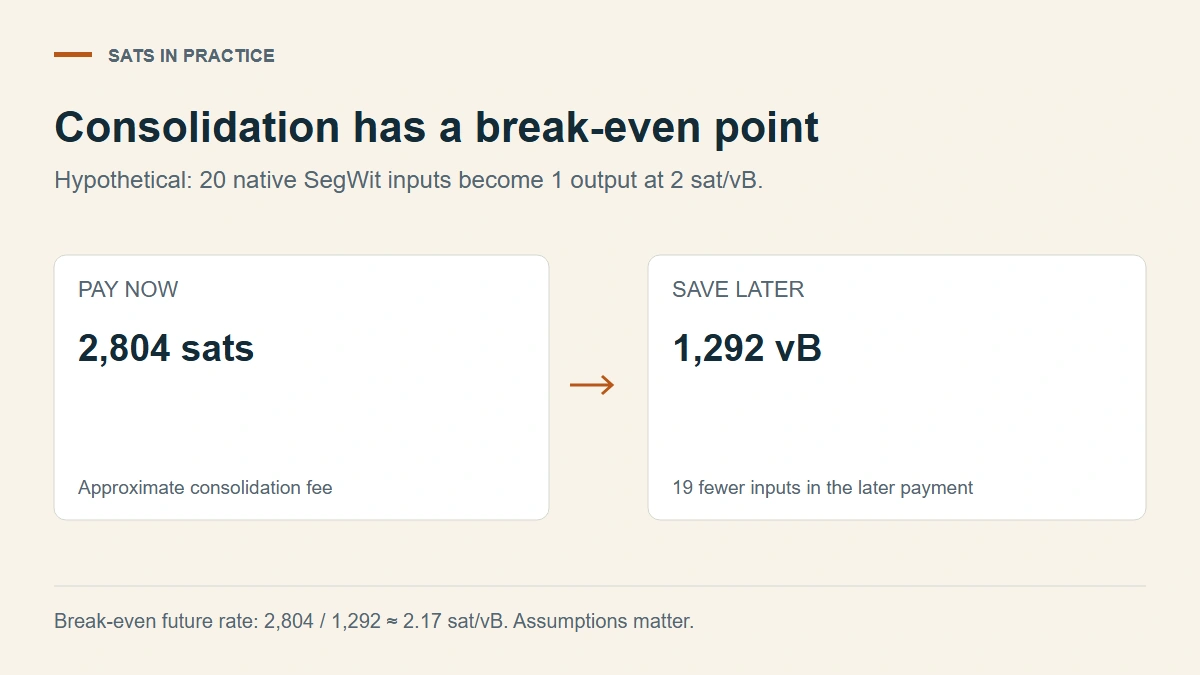
This is the 2 sat/vB case. The 2026 rates come next.
The model holds up against complete transactions. A later payment that spends twenty inputs to two outputs is about 1,433 vB, and one input to two outputs is about 141 vB. At 45 sat/vB, those cost 64,485 and 6,345 sats. The gap, 58,140 sats, is exactly 1,292 × 45.
Rerun it at today's fee rates
Fees in 2026 sit well below the 2 sat/vB used above. Blocks have typically paid about 1 sat/vB for the past year, and mempool.space's suggestions that day ran from 0.2 to 2 sat/vB (the 2026 fee picture). Plugging in two rates from that range:
- At 0.3 sat/vB, consolidation costs about 421 sats (1,402 × 0.3), and the break-even future rate is about 0.33 sat/vB.
- At 1 sat/vB, it costs 1,402 sats, and the break-even is about 1.09 sat/vB.
The future rate shouldn't be a guess. Use congestion Bitcoin has actually had: on mempool.space's block fee-rate chart, the monthly median was roughly 135 sat/vB in December 2023 and in the low 40s around the April 2024 halving.
| Future rate when you spend | Input fees avoided | Net if merged at 0.3 sat/vB | Net if merged at 1 sat/vB | Net if merged at 2 sat/vB |
|---|---|---|---|---|
| 1 sat/vB (2026 norm) | 1,292 sats | 871 sats | −110 sats | −1,512 sats |
| 2 sat/vB | 2,584 sats | 2,163 sats | 1,182 sats | −220 sats |
| 10 sat/vB | 12,920 sats | 12,499 sats | 11,518 sats | 10,116 sats |
| 45 sat/vB (near April 2024's median) | 58,140 sats | 57,719 sats | 56,738 sats | 55,336 sats |
| 140 sat/vB (near December 2023's median) | 180,880 sats | 180,459 sats | 179,478 sats | 178,076 sats |
At about $84,000 per BTC (use the day's price for your own figures), merging at 0.3 sat/vB costs around $0.35, while the fees avoided in a 2024-style congestion month would be worth roughly $50 to $150.
Pocket change now against real money in a busy month. That's the case for treating a low-fee period as a consolidation window, provided you really have a pile of small UTXOs you expect to spend together and you accept the privacy cost described below.
With three or four UTXOs, don't bother. The saving is small at any plausible rate.
Close to break-even on your own figures? Lower r_now rather than trying to forecast fees more precisely. A merge that can wait belongs at mempool.space's No or Low priority rate. The table shows why. Merging at 0.3 sat/vB comes out ahead even if fees never rise above the 2026 norm, while merging at 1 sat/vB loses 110 sats in that case and wins in every congested month on record. If a rerun at the low rate still leaves you within a few hundred sats of zero, call the fees a tie and decide on the other two questions: will you really spend these coins together, and are you comfortable linking them?
Below 1 sat/vB, expect slower confirmation. Bitcoin Core 29.1 lowered its default minimum relay fee rate to 0.1 sat/vB, but its release notes warn that transactions below the old floor aren't guaranteed to propagate or confirm until the lower defaults are widely adopted. Some wallets still won't build them. A consolidation isn't urgent, so waiting is fine. Just make sure Replace-by-Fee (RBF) is on, so you can raise the rate if it sits unconfirmed for days. Sparrow does that from its Transactions screen, and Trezor Suite with the Speed up button on the pending transaction (Trezor's RBF guide). Each bump adds to the fee, so recheck the break-even after one. If you leave it alone, nothing is lost: after about two weeks nodes may drop it, and the coins stay in their old outputs.
How big is a consolidation transaction?
With N inputs and one output of the same type, the size is roughly:
| Input type (address prefix) | Size in vB | 10 inputs | 20 inputs | 50 inputs |
|---|---|---|---|---|
| Native SegWit, P2WPKH (bc1q) | 10.5 + 68N + 31 | 722 | 1,402 | 3,442 |
| Taproot, P2TR (bc1p) | 10.5 + 57.5N + 43 | 629 | 1,204 | 2,929 |
| Legacy, P2PKH (1) | 10 + 148N + 34 | 1,524 | 3,004 | 7,444 |
At 1 sat/vB, the size in vB is also the fee in sats. Legacy inputs cost more than twice as much to consolidate, but they save proportionally more later, so the break-even lands in the same place. For twenty legacy inputs it's 3,004 ÷ 2,812 ≈ 1.07 times whatever rate you pay now. Very large merges hit a relay limit. Bitcoin Core treats transactions over 400,000 weight units (100,000 vB) as nonstandard, which is roughly 1,470 P2WPKH inputs.
These are planning figures; your wallet's unsigned preview gives the final size.
When the calculation overstates the saving
The formula assumes you'll later spend the whole group in one payment. In practice you may never do that, or you may split the merged coin again across several payments. The wallet may also add an input or build a different output structure than the one you modeled, and any of those needs a new comparison.
Privacy can outweigh the arithmetic. Combining exchange-linked savings, a personal payment, and a public donation places all three in one public transaction, and a fresh destination address doesn't undo that link. Bitcoin.org's privacy guidance lays out why those associations matter. If a group saves sats but links funds you wanted kept apart, leaving them separate is a perfectly good result.
Coins carrying inscriptions or other assets tied to particular sats are a separate case. A generic send-max consolidation can wreck the special handling those assets need, so follow asset-specific instructions instead.
If your wallet has no coin control
Many phone wallets choose coins automatically. Look on the Send screen for coin control, a UTXO list, or a coins view before deciding yours lacks one. If it has none, the only merge it can make is a send-max to one of its own receive addresses, and that takes every coin in the account, including any tiny receipt you don't recognize and any coins you meant to keep apart. Do that only when all the coins come from the same kind of source, such as your own exchange withdrawals, and none of them is an unexpected dust payment. Otherwise leave them. At 2026 rates, waiting costs little.
A hardware wallet doesn't need a new wallet to get coin control. Sparrow imports a Trezor through its Connected Hardware Wallet option (its FAQ covers it), so the recovery words stay on paper and the device still signs.
Bitcoin held on an exchange isn't a set of UTXOs in your name, so there's nothing for you to consolidate until you withdraw it.
Doing it in Sparrow
We matched the button names below against Sparrow's coin-control FAQ and sending guide in September 2026:
- Open the UTXOs tab (just above Settings). Select the outputs you plan to merge with Ctrl+Click (Cmd+Click on a Mac), then click Send Selected.
- In Pay to, use the drop-down arrow at the right of the address field to choose an address from this same wallet. Add a label that records what the group was.
- Click Max beside the amount so the whole selection goes to that address, minus the fee.
- Set the fee Rate, and compare the resulting fee with your break-even figure.
- Click Create Transaction. In the transaction editor, confirm that the inputs are exactly the ones you selected and that there's one output and no change.
- Click Finalize Transaction for Signing, sign (on a hardware wallet, check the address and amount on the device screen), then click Broadcast Transaction.
Sparrow enables RBF on the transactions it sends by default, which covers the low-fee caveat above. If your coins live in Trezor Suite instead, the same send-to-yourself flow is covered in our Trezor Suite consolidation walkthrough.